Preserved content from the existing Yee page.
With numerous challenges posed by maintenance of often complex building systems, it is little wonder that many building operators struggle to stay up-to-date with their legal responsibilities. This is especially true of air conditioning equipment and many may be unknowingly breaking the law. In this white paper Yee Group discuss the options open to building managers following the 1st January deadline. R22 is a hydrochlorofluorocarbon (HCFC), and was commonly used in equipment until it was categorised as ozone-depleting. It was phased out in the Ozone Depleting Substances Regulations EC2037/2000 &1005/2009. Any air conditioning system installed before 2002 is therefore likely to employ R22. New sources of R22 have already been phased out and consequently any equipment requiring R22 gas has essentially become redundant.
From 1st January 2015, it was illegal to use R22 to service industrial refrigeration and air conditioning. However, reliable and leak free R22 systems can still be legally operated, that is until they fail. Yee Group recommends checking whether your air conditioning system is operating R22.
The company advises that there are two options available in order to comply with the regulations. Firstly, these are to replace the whole system; secondly, to replace those units which are affected. Doing nothing is no longer an option, especially if you consider the implications for your business if the system were to fail. Replacing an air conditioning system may at first seem an expensive option; however, the latest equipment using refrigerant R410A is up to 60 percent more energy-efficient and your investment will be recouped in less than four years. Running a new system is likely to be cheaper than maintaining and running an older one. In addition to the energy savings and the cost benefits that new equipment brings, the most obvious advantage of running a modern system, utilising the latest technology, is that it is far less likely to suffer breakdowns, or cause unscheduled down-time. Deciding upon what course of action to take will be helped by considering the age and life expectancy of the system, its efficiency and any leakage problems that may already have been encountered.
Some might say that it is possible to convert equipment using a ‘drop-in’ refrigerant. Such conversions give little flexibility of response, e.g. if your current system is inefficient or oversized, the retrofilled system will probably be no better. If an existing system is old, inefficient, leaky, or ill-suited to the business’ needs, it will be more cost-effective to consider plant replacement.
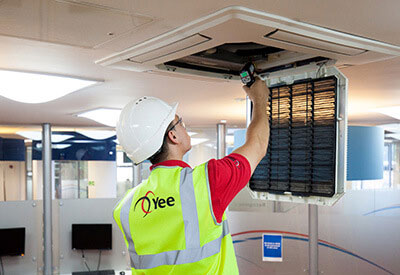
Responsive and adept at problem-solving, our engineers can carry out a comprehensive survey of your existing equipment and operational needs; and then provide advice on all the options and as well as explaining how the ban will affect you.
- Check now whether your air conditioning system is operating on R22.
- Consider the impact if the system were to fail.
- Make a plan to replace old units over coming months
- View Information about the air conditioning services we offer
- For more information and advice from Yee Group, click here to contact us or call us on 01283 523 849